


Coxarthrosis of the hip joint, a complex pathology of arthrosis, leads to serious changes in the articulation.Unfortunately, disability of mature people with loss of ability to work is common.In fact, statistics on hip joint disease account for almost half of all pathologies of the musculoskeletal system.I will give an example from the life of one case after surgical treatment and a rare complication during rehabilitation.
Coxarthrosis of the hip joint: a little about the disease
Osteoarthritis is a degenerative-dystrophic change that contributes to the complete destruction of cartilage with loss of joint function.
Coxarthrosis - here the hip joints are destroyed, practically, this is the same arthrosis.
In terms of its mechanism, the articulation of the hip with the pelvis is similar to door hinges.The head of the femur is connected to the ischium like a hinge.Which has a special anatomical formation - the acetabulum.This structure ensures maximum joint mobility.Which performs a full cycle of movements, or rather flexion, extension, rotation, etc.
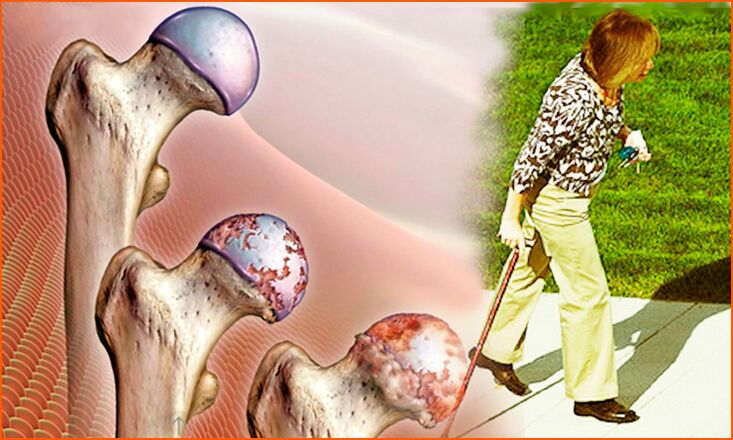
Normally, the articular surfaces are smooth, there is enough fluid inside, which ensures unhindered gliding.As the disease develops, the lubricant becomes thicker and more viscous, which immediately affects the condition of the cartilage.The synovial fluid no longer performs its functions completely.Because of this, shock-absorbing pads dry out, become cracked, and become rough.
- Firstly.As a result of the lack of necessary sliding, the friction of the bones increases, injuring them.
- Secondly.As it progresses, deformation of the bone surfaces also joins the altered cartilage tissue.The body thus tries to compensate for the increased load.
- Thirdly.Increased load leads to complete atrophy of the femoral muscles and weakness of the ligaments.
Important: osteoarthritis of the hip joint is a progressive disease.Changes can lead to a person’s complete loss of physical activity.Ultimately leading to disability.And completely disrupting the usual way of life.The disease and its treatment are extremely significant not only from a medical aspect, but are also a big social problem.
Causes of development of coxarthrosis and its types
At least there is no exact cause of coxarthrosis, which destroys the hip joint.There are only assumptions.Most cases of development of pathology of the hip joint are associated with congenital dislocation of the hip and dysplasia (inferiority) of the joint.
Therefore, there are 2 types of coxarthrosis;
- primary (arising from an unknown etiology);
- secondary (associated with injuries, diseases).
Primary osteoarthritis is characterized by a combination of factors:
- heredity;
- influence of biological, mechanical processes;
- excess weight;
- metabolic disorders;
- There is also a theory about pathological tissue restoration in response to damaging agents (inflammation, friction, infection).
Often this type of coxarthrosis is combined with damage to the spine and inflammatory phenomena of the knee joints (arthritis, arthrosis).
In the secondary version, the reasons for development are clearer.These include:
- Dysplastic disorders.In half of all cases of congenital pathology, grade 1 dysplastic coxarthrosis of the hip joint occurs.
- Hip dislocation (congenital).
- Life traumas.Fractures of the pelvis, femoral neck, dislocations, subluxations.
- Legg-Calvé-Perthes disease.Osteochondropathy of the femoral head with the development of its necrosis.This disease occurs in children when the blood supply and nutrition of the joint are impaired.
In addition, the pathology can affect both formations at once or be one-sided.In addition to the direct causes of occurrence, there are predisposing factors that provoke the development of the disease.Often the disease occurs with increased loads on the limbs of athletes.As well as people with difficult physical working conditions.Excess weight significantly increases the likelihood of arthrosis.
Provoking factors also include:
- Disruption of metabolic processes, joint nutrition, hormonal imbalances.
- Adynamia.
- Poor posture.Especially scoliosis, kyphosis, which lead to misalignment of the pelvic bones.
- Age after 40 years.It is estimated that after this date, every 10 patient is diagnosed with coxarthrosis of the hip joint, grade 1, 2.After 60, every third person is already observed.And when they reach the age of 70 or more, almost 80% of those who apply suffer from this pathology.
There is no specific gene that is responsible for the transmission of pathological changes in the joints.However, the hereditary factor can still be traced.A person can receive from relatives the structural features of cartilage tissue, altered metabolism, and skeletal pathology.It is the combination of such genetic information that can provoke the appearance of hip arthrosis.
Classification
The main division of the disease is based on severity.There are 3 stages, which differ not only in symptoms, but also in changes on the radiograph.It is these indicators that are taken as the basis for making a diagnosis.
Degree |
Signs |
|---|---|
I |
|
II |
|
III |
|
This division is the most common.There are also types of Kellgren classifications.It includes 4 stages, plus degree zero - the equivalent of a healthy joint.
Symptoms
The basis of all diseases of the musculoskeletal system is pain.Coxarthrosis of the hip joint of 1-2 degrees has symptoms less pronounced than with terminal stage 3.Initially, pain manifests itself during exercise.Especially after long walks or climbing stairs.Later, pain becomes a constant companion, significantly worsening the quality of life.
Coxarthrosis 1st degree
Unpleasant sensations are concentrated only in the joint area (the groin and buttock are practically not affected), rarely being reflected in the hip or knee.The pain is relieved by rest.
At this stage, no further manifestations are detected - the gait remains unchanged, there are no disturbances in movements.In the dysplastic variant, on the contrary, there is an increase in mobility due to changes in connective tissue; often in the initial stages of the disease, due to increased flexibility, patients become interested in gymnastics and yoga.Problems with movement occur only at stage 3.
For symptoms of stage 1 coxarthrosis of the hip joint, treatment can be carried out without surgery.Rational therapy allows you to eliminate unpleasant symptoms, stopping progression.
2nd degree of disease
The pain, although not constant, manifests itself at rest.Irradiation becomes noticeable - hip, groin, knee.Stiffness is observed - movements are limited in lifting, attempting to abduct to the side, difficulty in circular movements of the leg (pain especially often increases).Lameness becomes noticeable, which appears after intense walking or running.
When moving, a characteristic arthrosis crunch is heard - rough, dry.
3 degree osteoarthritis
The pain becomes constant and does not go away after rest and sleep.Unpleasant sensations do not leave the patient even at night.There are problems with walking; to facilitate movement, you have to use a cane.The lameness is constant.
At this stage, atrophy of the muscles of the limb occurs, and the leg itself shortens.These changes force the patient to bend to the affected side, further increasing the load on the joint.Limitation of mobility is observed in almost all directions.
Changes in bilateral coxarthrosis of the hip joint change the patient’s gait, which is why all formations involved in the walking process suffer.Lower back pain appears, posture is disturbed, and the axial position of the pelvis changes.
Diagnostics
An important role in determining the disease is an examination by an orthopedic surgeon, as well as a thorough analysis of complaints.It is worth assessing the patient's activity - the ability to climb stairs, comfort when putting on boots and socks, walking activity, use of a cane.
It is recommended to check the general condition - blood test, urine test, biochemistry, ECG, determination of HIV markers and syphilis.
Coxarthrosis of the hip joint of 1st degree has the most subtle symptoms.That is why it is worth conducting an X-ray examination to visualize changes in the joint space.This method allows not only to identify the disease.And also often find out the cause of the occurrence - dysplasia, Perthes disease.
Often, knee pain is much more pronounced with grade 1 deforming coxarthrosis of the hip joint, so it should be distinguished from gonarthrosis.The differential diagnosis also includes an examination of the spine to exclude radicular syndrome (it gives radiating pain to the hip and knee).
In doubtful cases, MRI (allows you to examine soft tissues in detail) and CT (to review bone formations) are used.
Treatment
The disease cannot be cured completely, but modern medicine can restore the lost ability to move, allowing you to live a full life.
The use of physiotherapy and medications is effective for grades 1-2 of the disease.In the terminal stage, only surgery helps.In another case, surgery is performed if the conservative therapy methods used do not bring relief.
Treatment 1st degree
Unfortunately, it is impossible to completely eliminate the pathology.In grade 1, treatment is aimed at stabilizing the condition.
During therapy, a number of general recommendations must be followed:
- Normalization of physical activity - it is recommended to reduce excessive stress (long hikes, running, jumping).
- Use shoes with good shock-absorbing soles and special insoles.
- Weight loss.
- Mandatory physical therapy.
Important: many patients completely refuse gymnastics and any exercise due to pain.This is often associated with the fear of increased pain and the possibility of worsening the situation.Practice proves that this opinion is wrong - regular exercise therapy helps strengthen muscles, protect them from atrophy, reduce pain and improve joint function.
A diet for grade 1 coxarthrosis of the hip joint is not prescribed; moderate nutrition is prescribed for weight loss.It is also useful to add products with gelatin, canned fish with bones, and dairy products to your diet.
Conservative
Non-steroidal anti-inflammatory drugs are used as a medicinal method.Due to the large number of side effects, it is recommended to take medications for intense pain.You can combine their use with gastroprotectors.
Persistent pain is relieved with intra-articular steroid injections, and pain-relieving blockades are also possible.
For support the following is prescribed:
- Muscle relaxants – relieve tension, reduce pain in the leg.
- Chondroprotectors – improve the restoration of cartilage tissue.
- Vasodilators (nicotinic acid) - help relieve vascular spasm and also increase tissue microcirculation.
Warming compresses are also used in combination (you can also use traditional methods of treatment).They do not provide a therapeutic effect, but they help relieve muscle spasms.
Be sure to use physiotherapy - UHF, magnetotherapy, induction currents, massage.
Hip replacement surgery
To restore freedom of movement in stage 3 and relieve intense pain, the patient is prepared for a planned endoprosthetic surgery.This is a special operation to replace a destroyed formation with an artificial one.The interventions completely restore the patient’s motor abilities.Helps you fully return to your normal lifestyle.
Depending on the extent of the process, the prosthesis can be either unipolar (only the worn head of the femur is replaced) or bipolar (the surface of the acetabulum is also changed).After the operation, rehabilitation is mandatory in order to return the patient to an active life as quickly as possible.
For patients over 60 years of age, the rehabilitation period is established even before surgical treatment, so that the recovery process takes place in a shorter period of time.The lifespan of an artificial joint is about 20 years, but it is important to follow the recommendations:
- Exclusion of running, long walking, jumping.
- Avoiding heavy lifting.
- Avoid excessive exposure to a forced static position (this is especially true for people with standing jobs).
Life incident
My friend’s husband required surgical treatment for endoprosthetics.He was not diagnosed with coxarthrosis, but had a lumbar hernia successfully removed.The condition did not improve, the examination continued, and finally, having found out what was wrong, they sent me for surgery under a quota.
After the replacement, everything grew back safely, but the second hip joint also required surgical intervention.A year later, the quota for the operation was again, which was successful.And then, from the first minutes after anesthesia, rehabilitation and strict adherence to the doctor’s recommendations are required.
And what about our friend?Already on the way home after the hospital, I began to put stress on the prosthetic joint (sitting for a long time, stepping on my foot).I forgot how careful I was the first time.As a result, the ligaments and muscles that did not have time to adapt to the implant could not hold it and it popped out.
Of course, they inserted it, put a cast on it, and then everything seemed to work out.But he complains that he cannot move his leg to the side, it hurts, and he feels discomfort when walking.Although he does exercises and various exercises to develop both joints, it is also work and the desire to move independently.
Prevention
We have discussed the symptoms and treatment of coxarthrosis in the hip joints, as well as their stages.
- Only daily physical exercise will help you avoid serious complications and live to a ripe old age without crutches.In Soviet times, serious work was carried out to prevent diseases of the musculoskeletal system and strengthen the immune system.Nowadays it’s difficult to restore the lost experience, it’s clear with the mind, but it’s too lazy to do it.
- Excess weight wears out joints to the point of disgrace; endoprosthetics is better, but not losing extra pounds.My friend is sure of this, without even trying to eat less sweets and starchy foods.Proper nutrition is a very important point.
- I consider lifting weights to be no less evil for the entire skeleton.
- Bad habits (alcohol, smoking) remove calcium, magnesium and other beneficial substances from the body.
Just dig, everything is interconnected.
Take care of yourself and your joints by exercising every day!